假设你需要生成数组 [1, 2, 3] 的所有排列。最直观的想法是写三重循环,每一层选择一个不同的元素——但如果数组长度是 10 呢?你需要写 10 层嵌套循环。更糟糕的是,如果数组长度不固定呢?
回溯算法为这类问题提供了一个优雅的通用解法:用递归模拟多层循环,在每一步做出选择,探索所有可能,并在需要时撤销选择、回退状态。这种"试错-回退"的模式,让它成为解决排列、组合、子集、棋盘问题等组合优化问题的核心技术。
回溯算法的本质
回溯(Backtracking)是一种通过探索所有可能解来解决问题的算法技术。它的核心思想非常朴素:从一条路往前走,能进则进,不能进则退。
1950年代,美国数学家 D. H. Lehmer 首次使用"backtrack"一词描述这种搜索策略。此后,这门技术在约束满足问题、组合优化问题中得到了广泛应用。1972年,Niklaus Wirth 在其著作《算法+数据结构=程序》中将回溯形式化为一种系统性的问题求解方法。
回溯算法可以被形式化地理解为在状态空间树上进行深度优先搜索(DFS)。树的每个节点代表问题求解过程中的一个状态,从根节点到叶子节点的路径代表一个完整的候选解。当发现某条路径无法得到有效解时,算法会"回溯"到上一个节点,尝试其他分支。
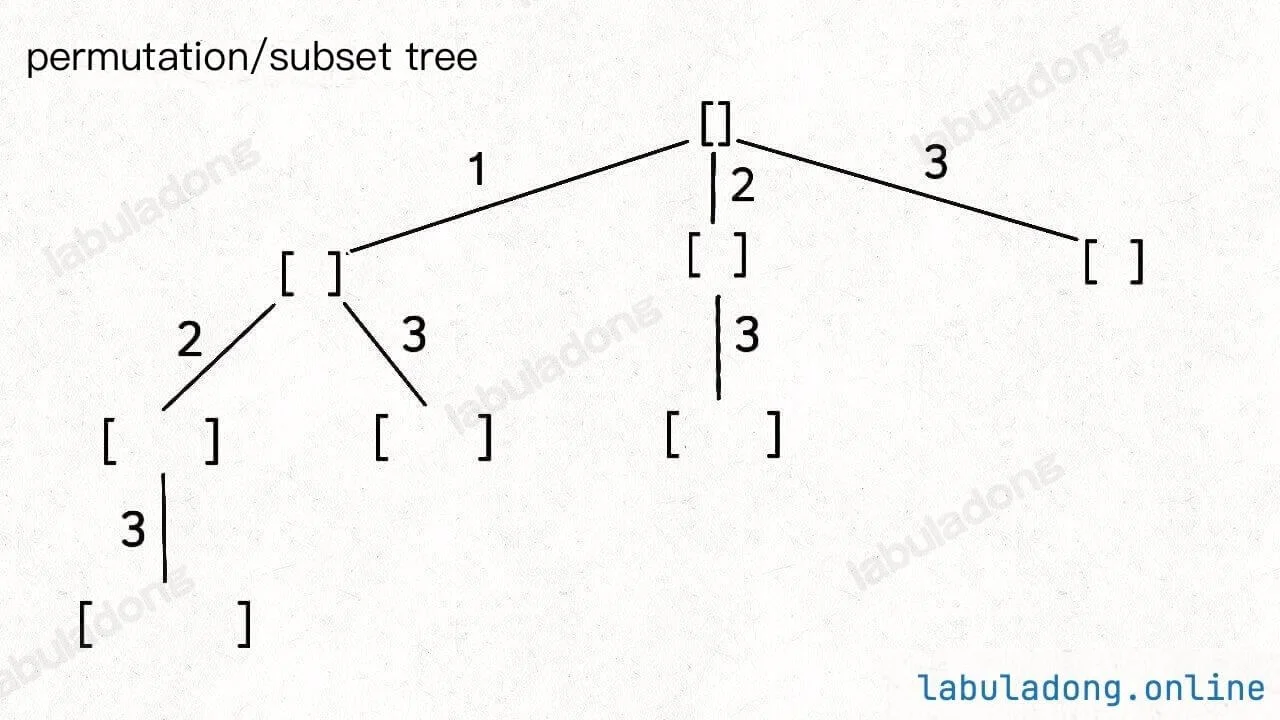
图片来源: labuladong 的算法小抄
回溯算法与普通 DFS 的关键区别在于剪枝。DFS 会遍历整棵树,而回溯会在探索过程中主动放弃那些明显不可能得到有效解的分支,从而大幅减少搜索空间。
三个核心操作
回溯算法的每一次递归调用都包含三个核心操作:
1. 做选择:将当前候选元素加入路径,更新状态。
2. 递归探索:基于当前状态继续向下探索。
3. 撤销选择:将之前的选择从路径中移除,恢复状态,为下一次选择做准备。
这三个步骤构成了回溯算法的基本框架。用伪代码表示:
void backtrack(路径, 选择列表) {
    if (满足结束条件) {
        result.add(路径);
        return;
    }
    for (选择 : 选择列表) {
        做选择;
        backtrack(路径, 选择列表);
        撤销选择;
    }
}
这个框架之所以强大,是因为它将复杂的组合问题分解为简单的"选择-探索-撤销"循环。每一层递归只需要考虑当前状态下的所有可能选择,而不需要关心之前或之后的决策。
LeetCode 回溯算法题目全景
回溯算法在 LeetCode 上有大量经典题目,可以按照问题类型分为以下几类:
| 类型 | 题目编号 | 题目名称 |
|---|---|---|
| 排列 | 46 | Permutations |
| 排列 | 47 | Permutations II |
| 组合 | 77 | Combinations |
| 组合 | 39 | Combination Sum |
| 组合 | 40 | Combination Sum II |
| 组合 | 216 | Combination Sum III |
| 子集 | 78 | Subsets |
| 子集 | 90 | Subsets II |
| 棋盘 | 51 | N-Queens |
| 棋盘 | 52 | N-Queens II |
| 棋盘 | 37 | Sudoku Solver |
| 字符串 | 17 | Letter Combinations of a Phone Number |
| 字符串 | 22 | Generate Parentheses |
| 字符串 | 93 | Restore IP Addresses |
| 字符串 | 131 | Palindrome Partitioning |
| 搜索 | 79 | Word Search |
| 其他 | 494 | Target Sum |
| 其他 | 784 | Letter Case Permutation |
接下来,我们将逐一分析这些经典题目,并提供完整的 Java 实现。
排列问题:元素顺序有影响
排列问题的特点是:从 n 个元素中选出 n 个,顺序不同则结果不同。比如 [1, 2, 3] 的全排列包含 [[1,2,3], [1,3,2], [2,1,3], [2,3,1], [3,1,2], [3,2,1]]。
LeetCode 46. Permutations
题目描述:给定一个不含重复数字的数组,返回其所有可能的全排列。
解题思路:每一层递归决定当前位置放哪个元素。为了保证每个元素只使用一次,需要维护一个 used 数组记录哪些元素已被选择。
class Solution {
    public List<List<Integer>> permute(int[] nums) {
        List<List<Integer>> result = new ArrayList<>();
        boolean[] used = new boolean[nums.length];
        backtrack(nums, new ArrayList<>(), used, result);
        return result;
    }

    private void backtrack(int[] nums, List<Integer> path,
                           boolean[] used, List<List<Integer>> result) {
        if (path.size() == nums.length) {
            result.add(new ArrayList<>(path));
            return;
        }

        for (int i = 0; i < nums.length; i++) {
            if (used[i]) continue;  // 剪枝:跳过已使用的元素

            used[i] = true;
            path.add(nums[i]);
            backtrack(nums, path, used, result);
            path.remove(path.size() - 1);
            used[i] = false;
        }
    }
}
复杂度分析:
- 时间复杂度:$O(n \times n!)$,共有 $n!$ 种排列,每种排列需要 $O(n)$ 时间复制到结果中。
- 空间复杂度:$O(n)$,递归深度最大为 $n$。
LeetCode 47. Permutations II
题目描述:给定一个可包含重复数字的数组,返回所有不重复的全排列。
解题思路:与上一题的区别在于数组中有重复元素,需要额外的剪枝来避免生成重复排列。关键技巧是先排序,然后在同一层递归中跳过与上一个元素相同的候选。
class Solution {
    public List<List<Integer>> permuteUnique(int[] nums) {
        List<List<Integer>> result = new ArrayList<>();
        Arrays.sort(nums);  // 排序是去重的前提
        boolean[] used = new boolean[nums.length];
        backtrack(nums, new ArrayList<>(), used, result);
        return result;
    }

    private void backtrack(int[] nums, List<Integer> path,
                           boolean[] used, List<List<Integer>> result) {
        if (path.size() == nums.length) {
            result.add(new ArrayList<>(path));
            return;
        }

        for (int i = 0; i < nums.length; i++) {
            if (used[i]) continue;
            // 剪枝:如果当前元素与前一个相同,且前一个未被使用(说明是同一层)
            // 则跳过,避免重复排列
            if (i > 0 && nums[i] == nums[i - 1] && !used[i - 1]) continue;

            used[i] = true;
            path.add(nums[i]);
            backtrack(nums, path, used, result);
            path.remove(path.size() - 1);
            used[i] = false;
        }
    }
}
去重逻辑解析:!used[i - 1] 的含义是:前一个相同元素在本层递归中刚刚被撤销选择,说明它是"同一层"的前一个选择。如果此时再选择当前元素,就会产生与之前相同的排列。
组合问题:元素顺序无关
组合问题与排列问题的核心区别在于:组合只关心选了哪些元素,不关心顺序。比如 [1, 2] 和 [2, 1] 是同一个组合。
LeetCode 77. Combinations
题目描述:给定整数 n 和 k,返回 1 到 n 中所有可能的 k 个数的组合。
解题思路:为了避免重复,我们需要保证每次选择时只考虑比上一个选择更大的元素。这就是通过 startIndex 参数实现的"向前看"策略。
class Solution {
    public List<List<Integer>> combine(int n, int k) {
        List<List<Integer>> result = new ArrayList<>();
        backtrack(n, k, 1, new ArrayList<>(), result);
        return result;
    }

    private void backtrack(int n, int k, int start,
                           List<Integer> path, List<List<Integer>> result) {
        if (path.size() == k) {
            result.add(new ArrayList<>(path));
            return;
        }

        // 剪枝优化:如果剩余可选元素不足,提前终止
        for (int i = start; i <= n - (k - path.size()) + 1; i++) {
            path.add(i);
            backtrack(n, k, i + 1, path, result);
            path.remove(path.size() - 1);
        }
    }
}
剪枝优化:循环上界从 n 改为 n - (k - path.size()) + 1。原理是:如果还需要选 k - path.size() 个元素,但剩余可选元素只有 n - i + 1 个,当后者小于前者时,可以直接跳过。
LeetCode 39. Combination Sum
题目描述:给定无重复元素的数组 candidates 和目标值 target,找出所有和为 target 的组合。同一数字可以重复选取。
解题思路:与上一题类似,但由于可以重复选取,递归时的起始索引不再是 i + 1,而是 i(允许再次选择当前元素)。
class Solution {
    public List<List<Integer>> combinationSum(int[] candidates, int target) {
        List<List<Integer>> result = new ArrayList<>();
        backtrack(candidates, target, 0, new ArrayList<>(), result);
        return result;
    }

    private void backtrack(int[] candidates, int target, int start,
                           List<Integer> path, List<List<Integer>> result) {
        if (target == 0) {
            result.add(new ArrayList<>(path));
            return;
        }
        if (target < 0) return;  // 剪枝:和已超过目标

        for (int i = start; i < candidates.length; i++) {
            path.add(candidates[i]);
            // 注意:这里传 i 而不是 i + 1,因为可以重复选取
            backtrack(candidates, target - candidates[i], i, path, result);
            path.remove(path.size() - 1);
        }
    }
}
LeetCode 40. Combination Sum II
题目描述:给定可能包含重复元素的数组 candidates 和目标值 target,找出所有和为 target 的组合。每个数字只能使用一次。
解题思路:结合了"去重"和"组合"两个要点。先排序,然后在同一层递归中跳过重复元素。
class Solution {
    public List<List<Integer>> combinationSum2(int[] candidates, int target) {
        List<List<Integer>> result = new ArrayList<>();
        Arrays.sort(candidates);
        backtrack(candidates, target, 0, new ArrayList<>(), result);
        return result;
    }

    private void backtrack(int[] candidates, int target, int start,
                           List<Integer> path, List<List<Integer>> result) {
        if (target == 0) {
            result.add(new ArrayList<>(path));
            return;
        }

        for (int i = start; i < candidates.length; i++) {
            // 剪枝:跳过同层重复元素
            if (i > start && candidates[i] == candidates[i - 1]) continue;
            // 剪枝:如果当前元素已超过剩余目标,后面的更大元素更不可能
            if (candidates[i] > target) break;

            path.add(candidates[i]);
            backtrack(candidates, target - candidates[i], i + 1, path, result);
            path.remove(path.size() - 1);
        }
    }
}
LeetCode 216. Combination Sum III
题目描述:找出所有相加之和为 n 的 k 个数的组合,数字范围 1-9,每个数字最多使用一次。
解题思路:这是组合问题的简化版本,候选集固定为 1-9。
class Solution {
    public List<List<Integer>> combinationSum3(int k, int n) {
        List<List<Integer>> result = new ArrayList<>();
        backtrack(k, n, 1, new ArrayList<>(), result);
        return result;
    }

    private void backtrack(int k, int n, int start,
                           List<Integer> path, List<List<Integer>> result) {
        if (path.size() == k && n == 0) {
            result.add(new ArrayList<>(path));
            return;
        }
        if (path.size() >= k || n <= 0) return;

        for (int i = start; i <= 9; i++) {
            path.add(i);
            backtrack(k, n - i, i + 1, path, result);
            path.remove(path.size() - 1);
        }
    }
}
子集问题:枚举所有可能
子集问题要求生成数组的所有子集,包括空集。从决策树的角度看,子集问题与组合问题的区别在于:子集问题在每个节点都要收集结果,而组合问题只在叶子节点收集。
LeetCode 78. Subsets
题目描述:给定不含重复元素的整数数组,返回所有可能的子集。
解题思路:每一层递归决定是否选择当前元素。注意在每个节点(包括根节点)都要将当前路径加入结果。
class Solution {
    public List<List<Integer>> subsets(int[] nums) {
        List<List<Integer>> result = new ArrayList<>();
        backtrack(nums, 0, new ArrayList<>(), result);
        return result;
    }

    private void backtrack(int[] nums, int start,
                           List<Integer> path, List<List<Integer>> result) {
        result.add(new ArrayList<>(path));  // 在每个节点收集结果

        for (int i = start; i < nums.length; i++) {
            path.add(nums[i]);
            backtrack(nums, i + 1, path, result);
            path.remove(path.size() - 1);
        }
    }
}
时间复杂度:$O(n \times 2^n)$。共有 $2^n$ 个子集,每个子集需要 $O(n)$ 时间复制。
LeetCode 90. Subsets II
题目描述:给定可能包含重复元素的整数数组,返回所有可能的子集(不能有重复子集)。
解题思路:排序 + 同层去重。
class Solution {
    public List<List<Integer>> subsetsWithDup(int[] nums) {
        List<List<Integer>> result = new ArrayList<>();
        Arrays.sort(nums);
        backtrack(nums, 0, new ArrayList<>(), result);
        return result;
    }

    private void backtrack(int[] nums, int start,
                           List<Integer> path, List<List<Integer>> result) {
        result.add(new ArrayList<>(path));

        for (int i = start; i < nums.length; i++) {
            if (i > start && nums[i] == nums[i - 1]) continue;  // 去重

            path.add(nums[i]);
            backtrack(nums, i + 1, path, result);
            path.remove(path.size() - 1);
        }
    }
}
棋盘问题:约束满足的典型
棋盘问题是回溯算法的经典应用场景,特点是需要在放置元素时检查多个约束条件。
LeetCode 51. N-Queens
题目描述:在 n×n 的棋盘上放置 n 个皇后,使其不能互相攻击。返回所有可能的放置方案。
解题思路:逐行放置皇后,每次放置时检查列、主对角线、副对角线是否已有皇后。
class Solution {
    public List<List<String>> solveNQueens(int n) {
        List<List<String>> result = new ArrayList<>();
        char[][] board = new char[n][n];
        for (int i = 0; i < n; i++) {
            Arrays.fill(board[i], '.');
        }
        backtrack(board, 0, result);
        return result;
    }

    private void backtrack(char[][] board, int row, List<List<String>> result) {
        if (row == board.length) {
            result.add(constructBoard(board));
            return;
        }

        for (int col = 0; col < board.length; col++) {
            if (!isValid(board, row, col)) continue;  // 剪枝

            board[row][col] = 'Q';
            backtrack(board, row + 1, result);
            board[row][col] = '.';  // 撤销选择
        }
    }

    private boolean isValid(char[][] board, int row, int col) {
        // 检查列
        for (int i = 0; i < row; i++) {
            if (board[i][col] == 'Q') return false;
        }
        // 检查左上对角线
        for (int i = row - 1, j = col - 1; i >= 0 && j >= 0; i--, j--) {
            if (board[i][j] == 'Q') return false;
        }
        // 检查右上对角线
        for (int i = row - 1, j = col + 1; i >= 0 && j < board.length; i--, j++) {
            if (board[i][j] == 'Q') return false;
        }
        return true;
    }

    private List<String> constructBoard(char[][] board) {
        List<String> result = new ArrayList<>();
        for (char[] row : board) {
            result.add(new String(row));
        }
        return result;
    }
}
优化技巧:可以用三个布尔数组分别记录已占用的列、主对角线、副对角线,将 isValid 检查降到 $O(1)$。
class Solution {
    public List<List<String>> solveNQueens(int n) {
        List<List<String>> result = new ArrayList<>();
        boolean[] cols = new boolean[n];
        boolean[] diag1 = new boolean[2 * n - 1];  // row - col + n - 1
        boolean[] diag2 = new boolean[2 * n - 1];  // row + col

        char[][] board = new char[n][n];
        for (int i = 0; i < n; i++) {
            Arrays.fill(board[i], '.');
        }

        backtrack(board, 0, cols, diag1, diag2, result);
        return result;
    }

    private void backtrack(char[][] board, int row, boolean[] cols,
                           boolean[] diag1, boolean[] diag2,
                           List<List<String>> result) {
        if (row == board.length) {
            result.add(constructBoard(board));
            return;
        }

        for (int col = 0; col < board.length; col++) {
            int d1 = row - col + board.length - 1;
            int d2 = row + col;

            if (cols[col] || diag1[d1] || diag2[d2]) continue;

            cols[col] = true;
            diag1[d1] = true;
            diag2[d2] = true;
            board[row][col] = 'Q';

            backtrack(board, row + 1, cols, diag1, diag2, result);

            board[row][col] = '.';
            cols[col] = false;
            diag1[d1] = false;
            diag2[d2] = false;
        }
    }

    private List<String> constructBoard(char[][] board) {
        List<String> result = new ArrayList<>();
        for (char[] row : board) {
            result.add(new String(row));
        }
        return result;
    }
}
LeetCode 37. Sudoku Solver
题目描述:解数独谜题。
解题思路:遍历每个空格,尝试填入 1-9,检查是否满足数独规则(行、列、3×3 宫格内无重复)。
class Solution {
    public void solveSudoku(char[][] board) {
        backtrack(board);
    }

    private boolean backtrack(char[][] board) {
        for (int row = 0; row < 9; row++) {
            for (int col = 0; col < 9; col++) {
                if (board[row][col] != '.') continue;

                for (char c = '1'; c <= '9'; c++) {
                    if (!isValid(board, row, col, c)) continue;

                    board[row][col] = c;
                    if (backtrack(board)) return true;  // 找到解立即返回
                    board[row][col] = '.';  // 回溯
                }
                return false;  // 1-9 都不行,无解
            }
        }
        return true;  // 所有格子都填满了
    }

    private boolean isValid(char[][] board, int row, int col, char c) {
        for (int i = 0; i < 9; i++) {
            if (board[row][i] == c) return false;  // 检查行
            if (board[i][col] == c) return false;  // 检查列
            // 检查 3x3 宫格
            if (board[3 * (row / 3) + i / 3][3 * (col / 3) + i % 3] == c) {
                return false;
            }
        }
        return true;
    }
}
字符串问题:分割与匹配
字符串相关的回溯问题通常涉及字符串的分割、匹配或生成。
LeetCode 17. Letter Combinations of a Phone Number
题目描述:给定数字字符串,返回所有可能的字母组合(电话号码对应字母)。
解题思路:每个数字对应多个字母,问题转化为在每一层选择一个字母,组合成所有可能的结果。
class Solution {
    private String[] mapping = {"", "", "abc", "def", "ghi", "jkl",
                                "mno", "pqrs", "tuv", "wxyz"};

    public List<String> letterCombinations(String digits) {
        List<String> result = new ArrayList<>();
        if (digits == null || digits.length() == 0) return result;
        backtrack(digits, 0, new StringBuilder(), result);
        return result;
    }

    private void backtrack(String digits, int index,
                           StringBuilder path, List<String> result) {
        if (index == digits.length()) {
            result.add(path.toString());
            return;
        }

        String letters = mapping[digits.charAt(index) - '0'];
        for (char c : letters.toCharArray()) {
            path.append(c);
            backtrack(digits, index + 1, path, result);
            path.deleteCharAt(path.length() - 1);
        }
    }
}
LeetCode 22. Generate Parentheses
题目描述:生成所有有效的括号组合。
解题思路:在任意位置,左括号数量必须大于等于右括号数量。利用这个约束进行剪枝。
class Solution {
    public List<String> generateParenthesis(int n) {
        List<String> result = new ArrayList<>();
        backtrack(new StringBuilder(), 0, 0, n, result);
        return result;
    }

    private void backtrack(StringBuilder path, int open, int close,
                           int n, List<String> result) {
        if (path.length() == 2 * n) {
            result.add(path.toString());
            return;
        }

        if (open < n) {  // 还可以放左括号
            path.append('(');
            backtrack(path, open + 1, close, n, result);
            path.deleteCharAt(path.length() - 1);
        }
        if (close < open) {  // 右括号数量必须小于左括号
            path.append(')');
            backtrack(path, open, close + 1, n, result);
            path.deleteCharAt(path.length() - 1);
        }
    }
}
LeetCode 93. Restore IP Addresses
题目描述:从数字字符串恢复所有可能的 IP 地址。
解题思路:IP 地址分为 4 段,每段 1-3 位数字,值在 0-255 之间。不能有前导零(除非是单独的 0)。
class Solution {
    public List<String> restoreIpAddresses(String s) {
        List<String> result = new ArrayList<>();
        backtrack(s, 0, new ArrayList<>(), result);
        return result;
    }

    private void backtrack(String s, int start, List<String> path,
                           List<String> result) {
        if (path.size() == 4) {
            if (start == s.length()) {
                result.add(String.join(".", path));
            }
            return;
        }

        for (int len = 1; len <= 3 && start + len <= s.length(); len++) {
            String segment = s.substring(start, start + len);
            // 剪枝:检查有效性
            if (segment.length() > 1 && segment.charAt(0) == '0') continue;
            if (Integer.parseInt(segment) > 255) continue;

            path.add(segment);
            backtrack(s, start + len, path, result);
            path.remove(path.size() - 1);
        }
    }
}
LeetCode 131. Palindrome Partitioning
题目描述:将字符串分割成若干回文子串,返回所有可能的分割方案。
解题思路:在每一步尝试所有可能的分割点,检查分割出的子串是否是回文。
class Solution {
    public List<List<String>> partition(String s) {
        List<List<String>> result = new ArrayList<>();
        backtrack(s, 0, new ArrayList<>(), result);
        return result;
    }

    private void backtrack(String s, int start, List<String> path,
                           List<List<String>> result) {
        if (start == s.length()) {
            result.add(new ArrayList<>(path));
            return;
        }

        for (int end = start; end < s.length(); end++) {
            if (!isPalindrome(s, start, end)) continue;  // 剪枝

            path.add(s.substring(start, end + 1));
            backtrack(s, end + 1, path, result);
            path.remove(path.size() - 1);
        }
    }

    private boolean isPalindrome(String s, int left, int right) {
        while (left < right) {
            if (s.charAt(left++) != s.charAt(right--)) {
                return false;
            }
        }
        return true;
    }
}
LeetCode 79. Word Search
题目描述:在二维网格中搜索单词是否存在。
解题思路:从每个位置开始 DFS,向四个方向探索。需要标记已访问位置以避免重复使用。
class Solution {
    public boolean exist(char[][] board, String word) {
        for (int i = 0; i < board.length; i++) {
            for (int j = 0; j < board[0].length; j++) {
                if (backtrack(board, word, i, j, 0)) {
                    return true;
                }
            }
        }
        return false;
    }

    private boolean backtrack(char[][] board, String word,
                              int row, int col, int index) {
        if (index == word.length()) return true;
        if (row < 0 || row >= board.length ||
            col < 0 || col >= board[0].length ||
            board[row][col] != word.charAt(index)) {
            return false;
        }

        char temp = board[row][col];
        board[row][col] = '#';  // 标记已访问

        boolean found = backtrack(board, word, row + 1, col, index + 1) ||
                        backtrack(board, word, row - 1, col, index + 1) ||
                        backtrack(board, word, row, col + 1, index + 1) ||
                        backtrack(board, word, row, col - 1, index + 1);

        board[row][col] = temp;  // 恢复
        return found;
    }
}
其他经典问题
LeetCode 494. Target Sum
题目描述:在数组每个元素前添加 + 或 -,计算所有可能的表达式值等于 target 的方案数。
解题思路:每个元素有两种选择:加或减。这可以转化为子集和问题。
class Solution {
    private int count = 0;

    public int findTargetSumWays(int[] nums, int target) {
        backtrack(nums, target, 0, 0);
        return count;
    }

    private void backtrack(int[] nums, int target, int index, int sum) {
        if (index == nums.length) {
            if (sum == target) count++;
            return;
        }

        backtrack(nums, target, index + 1, sum + nums[index]);  // 选择 +
        backtrack(nums, target, index + 1, sum - nums[index]);  // 选择 -
    }
}
优化:可以转化为 0-1 背包问题,使用动态规划将时间复杂度从 $O(2^n)$ 降到 $O(n \times sum)$。
LeetCode 784. Letter Case Permutation
题目描述:将字符串中的字母转换为大小写,返回所有可能的组合。
解题思路:对于每个字母,可以选择保持原样或转换大小写。
class Solution {
    public List<String> letterCasePermutation(String s) {
        List<String> result = new ArrayList<>();
        backtrack(s.toCharArray(), 0, result);
        return result;
    }

    private void backtrack(char[] chars, int index, List<String> result) {
        if (index == chars.length) {
            result.add(new String(chars));
            return;
        }

        if (Character.isLetter(chars[index])) {
            chars[index] = Character.toLowerCase(chars[index]);
            backtrack(chars, index + 1, result);
            chars[index] = Character.toUpperCase(chars[index]);
            backtrack(chars, index + 1, result);
        } else {
            backtrack(chars, index + 1, result);
        }
    }
}
剪枝技术的艺术
回溯算法的效率很大程度上取决于剪枝的质量。好的剪枝可以将指数级的时间复杂度大幅降低。以下是几种常见的剪枝策略:
1. 约束剪枝
在状态无效时立即返回,避免无效搜索。比如在组合求和问题中,当当前和已经超过目标值时停止。
if (currentSum > target) return; // 约束剪枝
2. 边界剪枝
当剩余选择不足以完成目标时提前终止。比如在组合问题中,如果剩余元素数量不足以凑齐 k 个,直接返回。
// 还需要选 need 个元素,剩余可选元素有 remaining 个
if (remaining < need) return;  // 边界剪枝
3. 重复剪枝
在数组有重复元素时,通过排序 + 跳过同层重复元素避免生成重复解。
if (i > start && nums[i] == nums[i - 1]) continue; // 重复剪枝
4. 可行性剪枝
在选择之前预判该选择是否可能成功。比如在 N 皇后问题中,放置皇后前检查是否冲突。
if (!isValid(board, row, col)) continue; // 可行性剪枝
复杂度分析与优化
回溯算法的时间复杂度通常是指数级的,但在实际应用中,有效的剪枝可以将搜索空间大幅压缩。
| 问题类型 | 时间复杂度 | 空间复杂度 |
|---|---|---|
| 排列 | $O(n \times n!)$ | $O(n)$ |
| 组合 | $O(k \times C_n^k)$ | $O(k)$ |
| 子集 | $O(n \times 2^n)$ | $O(n)$ |
| N皇后 | $O(n!)$ | $O(n)$ |
常见优化技巧
1. 预处理:排序数组,便于去重和提前终止。
2. 状态压缩:使用位运算替代布尔数组,减少空间占用。
3. 记忆化:对于存在重叠子问题的情况,可以用 HashMap 缓存中间结果。
4. 迭代加深:当只需要一个解时,可以用迭代加深搜索(IDS)优化。
总结
回溯算法的本质是在状态空间树上进行深度优先搜索,通过"选择-探索-撤销"的模式穷举所有可能解。它的强大之处在于框架的通用性——无论是排列、组合、子集还是棋盘问题,都可以用同一套模板解决。
掌握回溯算法的关键是理解三件事:
- 状态表示:如何用变量表示当前搜索状态?
- 选择集合:在当前状态下有哪些可选操作?
- 剪枝条件:如何提前判断某条路径不可能得到有效解?
当这三点想清楚后,套用回溯模板就是水到渠成的事。在实际刷题中,建议从简单的子集、组合问题入手,逐步挑战 N 皇后、数独等复杂问题,体会剪枝对效率的影响。
参考资料
- Wikipedia. Backtracking
- GeeksforGeeks. Backtracking Algorithms
- LeetCode Discuss. Backtracking algorithm + problems to practice
- LeetCode Discuss. Famous Backtracking Problems
- labuladong. Backtracking Algorithm to Solve All Permutation/Combination/Subset Problems
- Medium. A tree-based introduction to backtracking